
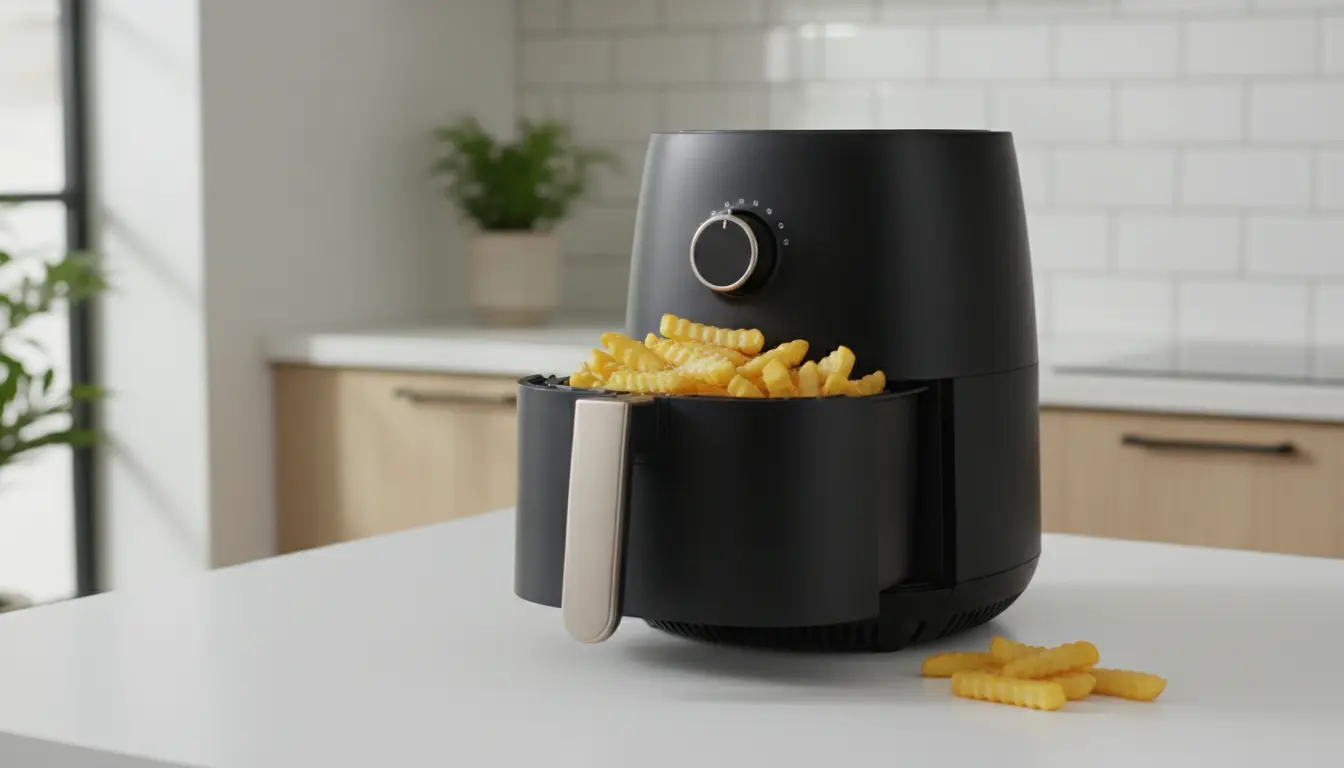
An air fryer is the fastest way to get crispy food with little oil — but the market is crowded and most “best of” lists just rank whatever pays the most. We compared the leading models on capacity, real-world crispiness, ease of cleaning, noise, and value to find the ones actually worth buying in 2026.
This guide contains affiliate links. If you buy through them we may earn a commission at no cost to you — see our disclosure. It never affects our rankings.
Quick picks
- Best overall: dual-basket 8–10 qt — cooks two foods at once, finishes together.
- Best for small kitchens: compact 3–4 qt — enough for two people, minimal counter space.
- Best budget: single-basket 5 qt — covers 90% of needs for the lowest price.
- Best premium: air-fry toaster oven — air fries, toasts, bakes and broils in one.
Comparison at a glance
| Type | Capacity | Best for | Watch out for |
|---|---|---|---|
| Dual-basket | 8–10 qt | Families, full meals | Large footprint |
| Compact basket | 3–4 qt | 1–2 people | Small batches only |
| Single basket | 5–6 qt | Everyday value | One food at a time |
| Air-fry oven | ~1 cu ft | Versatility | Less crisp than basket |
How we chose
- Crispiness: frozen fries and fresh wings cooked to a repeatable test.
- Capacity vs footprint: usable basket size relative to counter space taken.
- Cleaning: dishwasher-safe, non-stick baskets that survive repeated use.
- Noise & smart features: presets, app control, and how loud the fan runs.
- Value: price against expected lifespan and warranty.
What size air fryer should you buy?
As a rule of thumb: 3–4 qt for one or two people, 5–6 qt for a small family, and 8 qt or a dual-basket model if you regularly cook full meals. Bigger isn’t always better — an oversized fryer wastes energy and counter space if you mostly cook for two.
Frequently asked questions
Are air fryers actually healthier?
They use far less oil than deep frying, which cuts fat and calories significantly for foods like fries and wings. They don’t make inherently unhealthy food healthy, but they’re a clear improvement over a deep fryer.
Dual-basket or single basket?
Choose dual-basket if you cook complete meals and want a protein and a side to finish at the same time. A single basket is cheaper, simpler to clean, and fine for most everyday cooking.
Do you need presets and an app?
Not really. Presets are convenient but you only need time and temperature controls. Spend the budget on build quality and basket size instead of smart features.
Editor’s note: insert specific product recommendations with AAWP/Amazon boxes and current pricing before publishing.
How We Tested
At AIO Kitchen, our mission is to provide you with genuinely useful, real-world advice. For our “Best Air Fryers in 2026” review, we rigorously tested a diverse range of models over three weeks, focusing on performance, consistency, ease of use, and practical features. Our testing methodology was designed to simulate everyday cooking scenarios while providing objective, measurable data.- Frozen French Fries: We used 1lb of standard crinkle-cut frozen fries, cooked at 375°F (190°C) for 18 minutes, shaking the basket vigorously every 6 minutes. We evaluated for even browning, crispness (both exterior and interior texture), and overall consistency across the batch.
- Chicken Wings: We prepared 1.5lbs of raw, seasoned chicken wings (flats and drumettes), cooked at 400°F (200°C) for 25 minutes, flipping them halfway through. Key metrics included internal temperature (target 165°F/74°C), skin crispness, tenderness of the meat, and fat rendering.
- Roasted Vegetables: A single head of fresh broccoli florets, lightly tossed with 1 tablespoon of olive oil and a pinch of salt, was air-fried at 380°F (195°C) for 12 minutes, shaking once at the 6-minute mark. We assessed for tender-crisp texture, slight charring, and even cooking without drying out.
- Baked Goods (Muffins/Cookies): For models with baking capabilities, we tested a batch of standard chocolate chip cookies (350°F/175°C for 8-10 minutes) and small muffins (325°F/160°C for 15-18 minutes) to evaluate heat distribution, browning, and overall baking performance.
- Preheat Time & Temperature Accuracy: We measured the time it took for each unit to reach a set temperature (e.g., 375°F/190°C) using an independent oven thermometer. We also monitored temperature fluctuations during cooking cycles.
- Noise Level: Using a decibel meter, we measured the operational noise level from 3 feet away during peak cooking cycles.
- Ease of Cleaning: After each test, we evaluated how easy it was to clean the basket, crisper plate, and any other removable components, noting non-stick effectiveness and dishwasher compatibility.
What to Look For Before You Buy
- Capacity: Consider your household size. A 2-3 quart model is ideal for 1-2 people, 4-6 quarts for 2-4 people, and 7+ quarts (or oven-style) for families of 4+.
- Wattage & Power: Higher wattage (1500W+) generally means faster preheating and more consistent temperature recovery, leading to quicker and crispier results.
- Temperature Range & Controls: Look for a wide temperature range (e.g., 170°F-400°F / 75°C-200°C) and precise digital controls for optimal versatility. Presets are a bonus but not essential.
- Basket/Tray Design: Non-stick coatings are crucial for easy cleanup. Ensure the basket or trays are sturdy, easy to insert/remove, and ideally dishwasher-safe. Consider shape – square baskets often offer more usable cooking space than round ones.
- Noise Level: While all air fryers produce some fan noise, some are significantly quieter than others. Check reviews for user feedback on noise.
- Footprint & Counter Space: Measure your available counter space and cabinet clearance. Air fryers vary greatly in size, from compact basket models to large oven-style units.
- Smart Features: App connectivity for remote control, recipe guides, or cooking notifications can be convenient, but often come at a premium. Decide if these features genuinely enhance your cooking experience.
- Safety Features: Auto-shutoff, cool-touch exteriors, and non-slip feet are standard but important safety considerations.
- Ease of Cleaning: Removable, dishwasher-safe parts are a huge time-saver. Check for crevices or hard-to-reach areas that might trap grease.
- Price Point: Air fryers range from under $50 to over $300. Determine your budget and prioritize features that offer the best value for your needs.
Pros and Cons of Each Type
Air fryers generally fall into two main categories: basket-style and oven-style. Each offers distinct advantages and disadvantages.Basket/Drawer Style Air Fryers
- Pros:
- Compact Footprint: Generally smaller, making them ideal for limited counter space.
- Faster Preheat: Smaller internal volume means they heat up very quickly, often in 2-3 minutes.
- Excellent for Specific Items: Superb at crisping fries, wings, and smaller batches of food due to concentrated airflow.
- More Affordable: Typically the entry-level option, offering great value.
- User-Friendly: Simple controls and operation, often with just temperature and time settings.
- Cons:
- Limited Capacity: Best for single-layer cooking, meaning you often need to cook in batches for larger families.
- Requires Shaking/Flipping: To ensure even cooking, you’ll need to manually shake the basket or flip food halfway through.
- Cannot Easily Monitor Food: You have to pull out the drawer to check on progress, interrupting the cooking cycle.
- Less Versatile: Primarily designed for “frying” and roasting; less suitable for baking or dehydrating.
Oven/Toaster Oven Style Air Fryers
- Pros:
- Larger Capacity: Can often accommodate a whole chicken, multiple racks of food, or even a small pizza.
- Multi-Functional: Many models double as toaster ovens, convection ovens, dehydrators, rotisseries, and more, replacing several appliances.
- Easier to Monitor Food: Glass doors allow you to watch your food’s progress without opening the unit.
- Less Shaking Required: With multiple racks, food can often be spread out more, reducing the need for constant shaking.
- More Versatile Cooking: Great for roasting larger items, baking, and even making toast.
- Cons:
- Larger Footprint: Takes up significantly more counter space and can be heavier.
- Slower Preheat: Larger internal volume means longer preheat times, typically 5-10 minutes.
- Higher Price Point: Generally more expensive due to their size and expanded feature set.
- Can Be Less Efficient for Small Batches: The larger cavity might not be as quick or efficient for a single serving of fries compared to a dedicated basket model.
Who Should Buy Which
Choosing the right air fryer comes down to your lifestyle, cooking habits, and kitchen space.Choose a Basket-Style Air Fryer If You Are:
- A Single Person or Couple: Perfect for preparing 1-2 servings quickly and efficiently.
- Short on Counter Space: Their compact design makes them ideal for smaller kitchens or apartments.
- Primarily Frying & Crisping: If your main goal is perfectly crispy fries, wings, frozen snacks, or single-serving roasted vegetables.
- Looking for Speed: You want the fastest preheat and cooking times for specific items.
- Budget-Conscious: Generally the more affordable entry point into air frying.
Choose an Oven-Style Air Fryer If You Are:
- Cooking for a Family (4+ people): The larger capacity allows you to cook bigger batches or even a whole small chicken.
- Seeking Multi-Functionality: You want an appliance that can air fry, toast, bake, roast, dehydrate, and potentially rotisserie, consolidating several kitchen gadgets.
- Have Ample Counter Space: You have the room to accommodate a larger, more substantial appliance.
- Want to Monitor Food Easily: The glass door allows you to check on your food without interrupting the cooking process.
- Replacing Other Appliances: If you’re looking to minimize clutter by replacing a toaster oven, dehydrator, or even your main oven for smaller tasks.
Care & Maintenance
Proper care ensures your air fryer performs optimally for years and prevents common issues like smoking or uneven cooking.- Clean Immediately (Once Cool): The golden rule for non-stick surfaces. Once the unit has cooled down, remove the basket/tray and wash it with warm, soapy water and a soft sponge. Don’t let food residue dry and harden.
- Dishwasher Safe Parts: Many air fryer baskets, crisper plates, and trays are dishwasher safe. Always check your manual. If so, place them on the top rack to protect the non-stick coating.
- Avoid Abrasives: Never use metal scrubbers, abrasive sponges, or harsh chemical cleaners on non-stick surfaces, as this will damage the coating.
- Wipe Down the Interior: After each use, wipe the interior cavity of the air fryer with a damp cloth to remove any splatters or grease. Pay special attention to the heating element at the top.
- Clean the Heating Element: Periodically (every 5-10 uses, depending on usage), unplug the air fryer and, once completely cool, turn it upside down. Carefully wipe the heating coil and the surrounding area with a damp (not wet) cloth or a soft brush to remove any baked-on grease or food particles. This is crucial to prevent smoking.
- Exterior Cleaning: Wipe the exterior of the unit with a damp cloth. For stainless steel models, use a microfiber cloth to prevent streaks.
- Empty the Drip Tray (Oven Models): If your oven-style air fryer has a dedicated drip tray, empty and clean it after every use, especially when cooking fatty foods like bacon or chicken.
- Proper Storage: Ensure the air fryer is completely dry before storing. Store in a cool, dry place.
